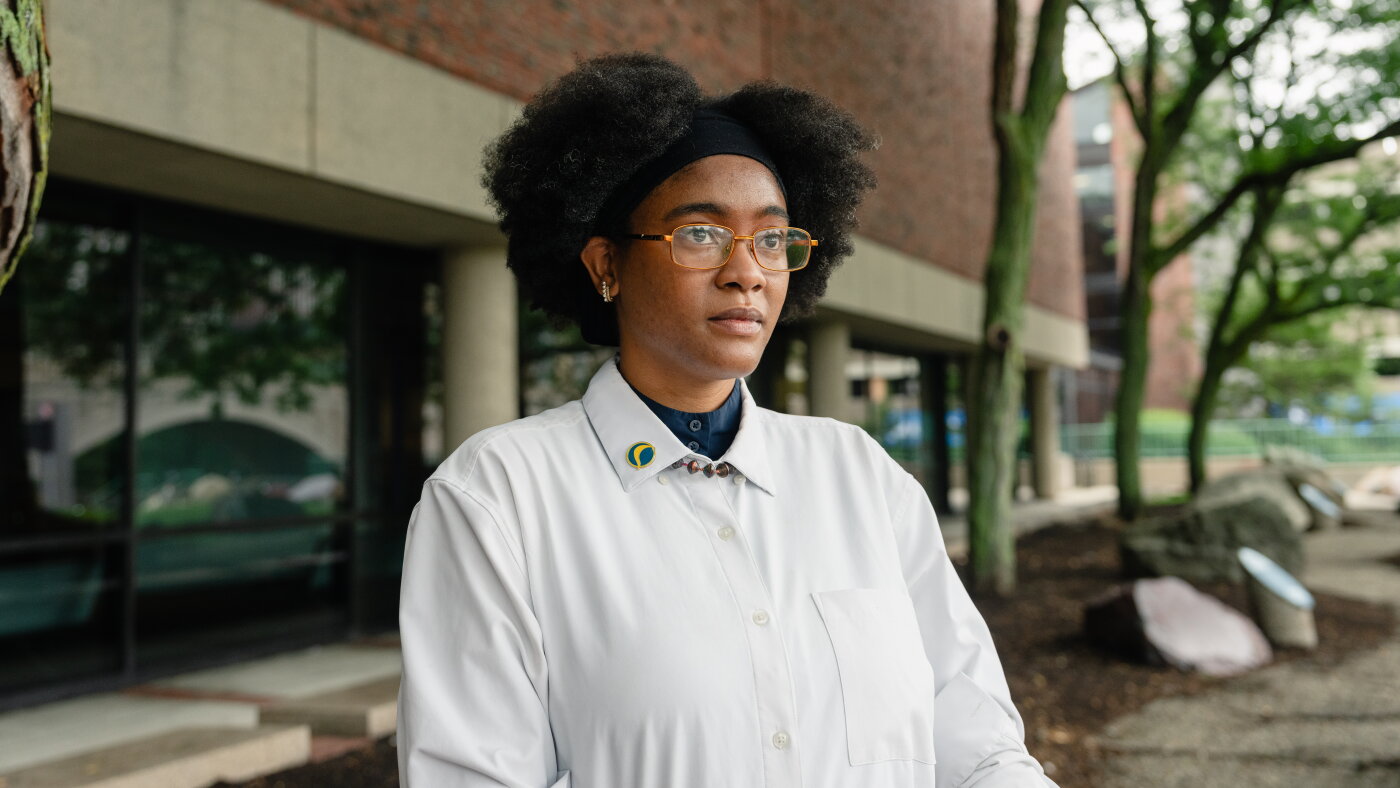
Netia McCray stands outside the Museum of Science, where she runs a STEM educational program for teens, in Boston, Mass. McCray has been suffering from long COVID since 2020.
Lucy Lu for NPR
hide caption
toggle caption
Lucy Lu for NPR
Netia McCray recalls how excited she was to join the federal advisory committee on long COVID in 2025. She had been diagnosed in the early days of the pandemic — and symptoms such as fatigue, heart palpitations and shortness of breath had become a frustrating but inescapable part of life.

By joining this group of doctors, researchers and other experts advising on the disease, McCray, 36, had hoped to channel her years of experience as a long-COVID patient into “something that could benefit so many individuals like myself and my community,” she says. The work, she felt, could make her part of the solution for a debilitating condition that impacts millions of Americans.

Netia McCray speaks with her students at the Museum of Science.
Lucy Lu for NPR
hide caption
toggle caption
Lucy Lu for NPR
But McCray had only been on the committee for a few months when she received an email notice that the group was terminated, “effective immediately.”

McCray’s advisory group is one of more than 100 science-focused federal committees that have been terminated under the second Trump administration, according to a news analysis in the journal Nature. As of March of this year, more than a quarter of the country’s healthcare-related committees have been shut down, according to the advocacy group Public Citizen.
As a result, McCray is one of hundreds of experts who are no longer meeting to work on some of the most intractable and urgent problems around health and science in the United States. The losses linked to the demise of these groups are difficult to quantify, but participants and advocates say the impacts will reverberate across federal agencies for years.

A rare team of cross-functional experts
McCray — who runs a nonprofit helping high school students access opportunities in STEM — was joined on the committee by pediatrician Dr. Alexandra Yonts, at Children’s National Hospital in Washington, D.C. Yonts, one of the few experts in the country who specializes in long COVID in children, was also eager to contribute to the advisory group. Patients often travel long distances to be seen in her clinic. She has frustratingly few options.

“ We need new therapeutics,” says Yonts.
Twelve other experts from a cross section of relevant fields including public health, pulmonology, and critical care joined this group to think together about how to galvanize new solutions.
But the committee never had a single meeting.

A hallmark of American government
The U.S. has long relied on a system of gathering outside experts from a range of backgrounds in order to advise federal agencies on complex issues. It was formalized in 1972, when Congress passed the Federal Advisory Committee Act, or FACA. The committees are composed primarily of volunteers, and draw from across fields of relevant study and practice.

Today, the list of science-related issues that these committees are convened to explore is vast and ranges from astrophysics to public health to biomedical research — advising on questions such as when and which vaccines children should receive, how often people should be screened for cancer, or how best to prevent asteroids from hitting the Earth.
“ The beauty of FACA is that it brings brilliant minds together for issues of the day, and allows them to openly adjudicate and to prioritize with limited resources how to get to next steps,” says Michael Abrams, a health researcher at the group Public Citizen who published a report on these terminated committees and describes them as a kind of connective tissue that helps facilitate good government.
The Union of Concerned Scientists – an advocacy group for researchers and scientists – now counts 150 advisory committees at science agencies terminated in 2025 alone.
Officials from the White House did not respond to requests as to why specific committees were terminated, but said in a statement that the dissolved committees “were found to be redundant, unnecessary, or ineffective.”
Yet outside science advocacy groups worry that without them, important issues of science and research will be neglected and siloed within federal agencies. “ What advisory committees can do is give a diversity of viewpoints and an independence of viewpoints that no one organization will ever have,” says Russ Paulsen, President and CEO of the the science advocacy group Research!America.
Terminated committees include those devoted to topics such as managing fisheries and sustaining U.S. seafood resources; planning future NASA space science and astrophysics missions; and reducing preventable infections in hospitals.
No substitute for real world perspective
People with real-world experience working in healthcare, says infectious disease researcher Hilary Babcock, offer invaluable perspective to officials at federal agencies like the Centers for Disease Control and Prevention — by helping them to put theory into practice. Babcock was on the Healthcare Infection Control Practices Advisory Committee, or HICPAC, before it was terminated.
“They don’t need help necessarily knowing what the literature shows,” says Babcock. “But what they don’t do is work in hospitals and healthcare systems, so they don’t necessarily understand intuitively what it means to try to operationalize findings from literature into guidance.”
One example is the drug-resistant fungus Candida auris, one of many issues that Babcock and her colleagues were grappling with in their work on the committee.
Candida auris can live on surfaces in healthcare facilities and cause deadly infections in humans. Cases have risen sharply in recent years as clinicians have struggled to find interventions to treat it.
The fungus can spread between patients and resist some antifungal treatments. Babcock worries that the fungus is not getting the attention it deserves without the work of the committee. “ There is some sort of interim guidance around Candida auris from the CDC, but we’re not getting updated guidance,” she says.
The fungus requires specific disinfectant practices in order to eradicate it..
Scott Roberts, an infectious disease doctor at Yale, has treated patients in the U.S. with Candida auris and worries that without a federal advisory committee to offer best practices on treating it, doctors like himself will be left with a patchwork of protocols, especially those at smaller or rural facilities. That patchwork, he says, could leave room for the fungus to spread.
“Losing a federal advisory committee on this is only going to make the problem worse,” says Roberts.
Checks on authority
Other participants from advisory groups say these groups offer important checks on authority for officials inside the government.
“As a federal official, I found advisory committees to be really helpful to me in my thinking and policy development,” says Carrie Wolinetz, who for years worked with advisory committees in her capacity as an official at the National Institutes of Health. Wolinetz now works outside government in healthcare policy and advocacy.
“They would bring up real-world issues that I — from within government — would not necessarily have thought of.”
Juan Meza, a professor of applied mathematics at the University of California, Merced, has served on a number of advisory committees during his career. Meza recalls an occasion years ago when one committee he served on advised federal leadership at the Department of Energy against making an investment in supercomputers.
“ The fact that we were supposed to be independent, I think gave us a certain amount of leeway to say, ‘No. We’ve gotta go with what we think is right,” says Meza. Reluctantly, he adds, leadership followed their advice.
Even when leadership does not take recommendations from committees, they create important transparency in government, says Kelly Holley-Bockelmann, a professor of astrophysics who until recently worked at Vanderbilt University. Holley-Bockelmann served on the Astrophysics Advisory Committee before it was terminated.
“ There were a couple times where we offered expertise that was not listened to,” says Holley-Bockelmann, “But nonetheless, we felt it was really important to get it down on record.”
In a statement, NASA officials called the termination of the astrophysics committee a “restructuring,” writing that they had merged several committees into one. The statement asserts that the agency “has remained committed to continuing to engage with the science community in a variety of ways.”
But others who work in the NASA ecosystem say the previous structure of committees offered an important way to gather information from stakeholders at all levels.
The committees allowed the space agency’s leaders to “hear almost directly from the community,” says Amanda Hendrix, CEO of the Planetary Science Institute and a former member of another federal committee called the NASA Advisory Council.
That advisory group historically helped set the agenda for NASA priorities, she says, and pushed the agency to offer explanations as to why they made the investments they did for future years.
It’s a rare tool of American government, says Hendrix, that provides this kind of accountability and window into decision making.
“ I felt like the interactions with NASA folks at the different committee levels was very useful and important for the community,” says Hendrix. “So it’s really disappointing that that’s all gone now.”