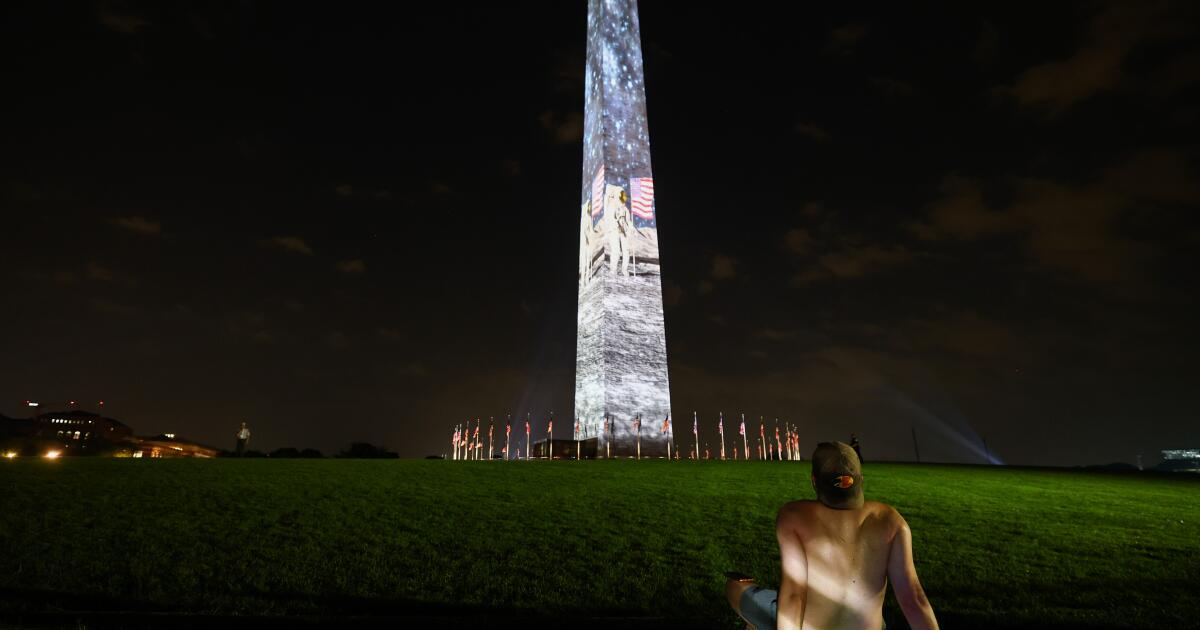
WASHINGTON — Small towns across America had big plans to celebrate the nation’s semiquincentennial this weekend. Local historical societies scheduled town square readings of the Declaration of Independence, hired bands to play patriotic tunes, organized parades and set up themed baking contests.
But many of their most ambitious plans were scrapped after the Trump administration cut $100 million in federal funding for humanities nonprofits and state councils at the start of its term. The decision severely hampered local planning for America’s 250th anniversary, disrupting history projects, museums and educational programs nationwide.
Instead, the Trump administration funneled tens of millions in federal dollars to Event Strategies, the firm behind Trump’s infamous rally at the Ellipse on Jan. 6, 2021, to organize anniversary events throughout the nation’s capital centered on President Trump.
The result, historians say, has become a centralized, more politicized spectacle, marking the national milestone as a celebration of an imperial presidency rather than a revolution from kingly rule.
The spectacular show that Americans will see features Trump at its center, culminating a year of concerted efforts by the president to put his face on passports and currency, national park passes and government buildings.
Members of the Dance4Life studio in Claymont, Del., prepares to march ahead of the Red, White, & Blue To-Do Pomp & Parade on July 2, 2026, in Philadelphia.
(Al Drago / Getty Images)
Yet, beyond the noise of the nation’s capital, historians and teachers, docents and curators, archivists, tour guides and reenactors have sustained the messy, organic discourse of the American story, less funded but no less vocal in their patriotism.
“The way history has been argued since Trump returned to office has been a reminder that governments and political figures have remarkable power to shape a society’s historical memory,” said David Ekbladh, a history professor at Tufts University and author of “Look at the World: The Rise of an American Globalism in the 1930s.”
Trump’s effort to control the anniversary narrative has reminded Ekbladh of one of George Orwell’s most famous quotes: “Who controls the past controls the future. Who controls the present controls the past.”
“The administration’s clear signals that it can and will restrict funding to institutions seems to have muted the way many institutions, like museums and universities, have approached the anniversary,” Ekbladh added. “With this said, Trump’s own direct, personal use of the 250th has been less about articulating a clear view of the nation’s history than using the moment itself to keep attention on him.”
The White House has taken a more active role in the festivities than initially planned, setting up its own Freedom 250 project to supplement America250, a bipartisan congressional effort to celebrate the occasion.

Fencing is seen around the Great American State Fair on the National Mall on Thursday.
(Kevin Dietsch / Getty Images)
The Trump administration has directed funding to events centered on the president’s attendance, primarily around Washington, and partnered with conservative organizations such as PragerU and Hillsdale College to present the country’s founding story through a conservative Christian lens.
Historians are in broad agreement that this year’s celebration has garnered far less attention than the bicentennial, marked in 1976, which generated blanket media coverage and widespread national excitement.
Andrew Rudalevige, a professor of government at Bowdoin College and author of “The New Imperial Presidency,” attributed the lack of enthusiasm this time in part due to a more fragmented media landscape than existed 50 years ago, denying the country a “core curriculum” and a shared story.
“I don’t think it’s a lack of patriotism, so much as a determination that no presidential administration should be able to center itself as the focus of that patriotism,” Rudalevige said.
“There’s a lot to celebrate in the text of the declaration. But that’s not where the focus of the Freedom 250 efforts has been,” Rudalevige said. “It would have been interesting to see what the bipartisan America250 initiative could have come up with if its funding and energies had not been diverted.”

The Lincoln Memorial Reflecting Pool is fenced off in preparation for Fourth of July fireworks.
(Kevin Dietsch / Getty Images)
Trump has scheduled little national travel around the anniversary, visiting North Dakota this week for an event that allowed him to debut a new version of Air Force One, donated by Qatar and outfitted to the president’s tastes. Trump intends to keep the plane after leaving office for his personal use.
The jet will fly over the National Mall alongside the Defense Department’s most impressive equipment on Saturday, before the president delivers a speech in what is forecast to be a blistering heat wave. The evening will end, according to administration officials, with the largest fireworks display in U.S. history.
“The fundamental challenge that we face now is the fight between the historians — people who have been studying the past and who have been thinking about how to tell that story to the public — and government leaders over who gets to control that story,” said Peter Kastor, chair of the history department at Washington University in St. Louis.
“The people who are really on the front lines are museum professionals, the operators of historic sites and schoolteachers,” he said. “They face the responsibility for explaining the past to a general audience on a day-to-day basis, and they are the ones who most often face the backlash from people who want the story to be told differently.”