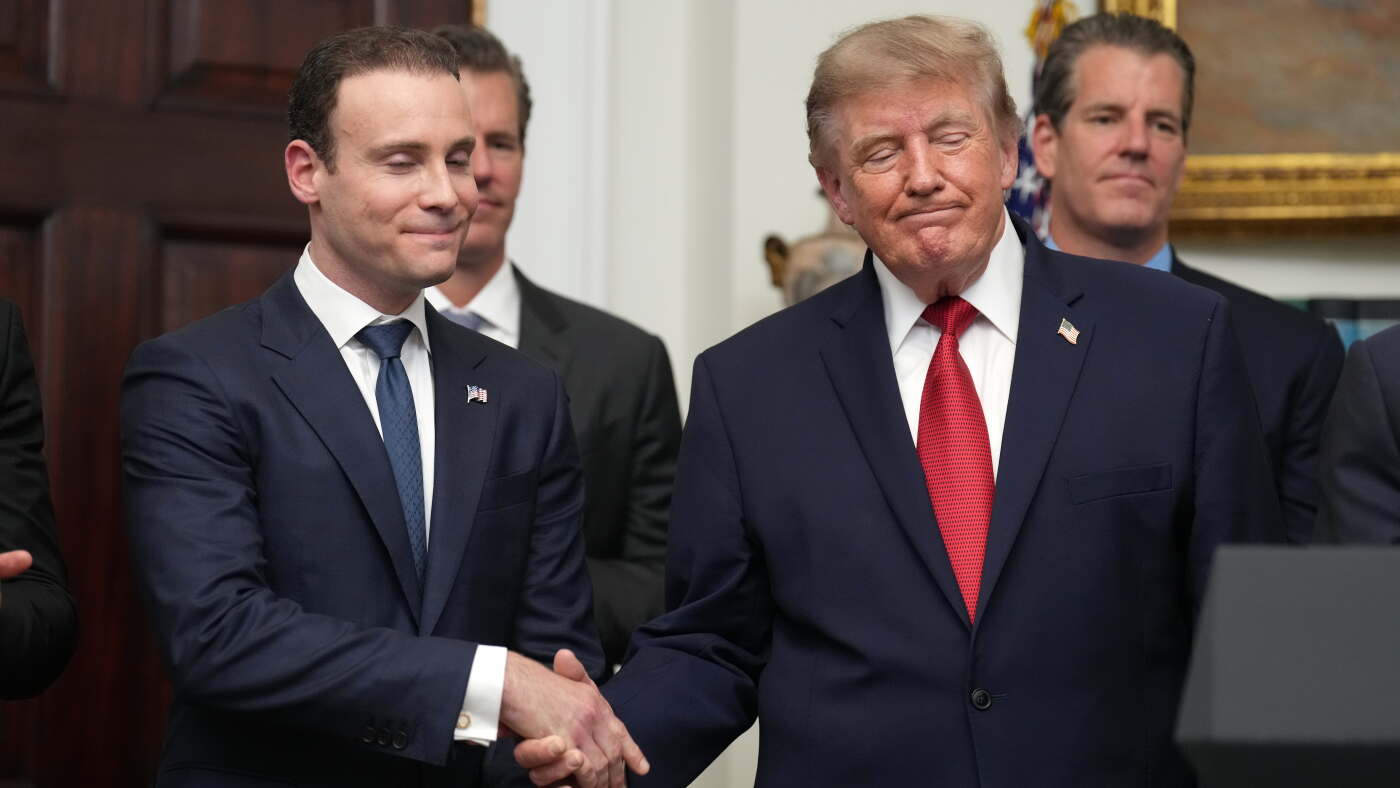
President Donald Trump shakes hands with Commodity Futures Trading Commission (CFTC) Chairman Michael Selig during a meeting with technology leaders in the Roosevelt Room of the White House, Wednesday, Aug. 19, 2026, in Washington.
Jacquelyn Martin/Associated Press
hide caption
Jacquelyn Martin/Associated Press
Trump-era staff reductions have significantly hampered enforcement at the Commodity Futures Trading Commission and its ability to regulate burgeoning new prediction and cryptocurrency markets, where hundreds of billions are traded each week.
By the end of 2025, the CFTC had 21% fewer staff on its payroll when compared to the previous 10-year average, according to U.S. Office of Personnel Management data. Between January 2024 and January 2025 alone, staffing dropped 22%. And the number of CFTC enforcement actions dropped even further. The agency made nearly 80% fewer enforcement actions in 2025 when compared to the annual average for the previous decade, according to the agency’s annual reports.

The CFTC started hemorrhaging staff soon after President Trump won the 2024 election. This was not a coincidence, according to Jeff Le Rich, who worked as a CFTC enforcement lawyer between 2005 and 2025.
“The Trump administration had run partially on a platform that it would be friendlier to the crypto industry,” Le Rich said.
Leading up to the 2024 election, the CFTC under the Biden administration had leveled enforcement cases against cryptocurrency companies such as Gemini, Mirror Trading, Voyager, Celsius and FTX for fraud. It did the same against the crypto prediction market Polymarket.
After President Trump’s inauguration, “in order to show results to that industry, some people were punished for bringing those cases,” Le Rich continued. “The end result was that a lot of the people that worked on those cases either left or were forced out.”

In a statement to NPR, the CFTC did not address that claim directly, but praised the work of current agency head Michael Selig.
“The CFTC remains committed to promoting integrity and responsible innovation in U.S. derivatives markets, and Chairman Selig is grateful to the dedicated staff who continue to support this mission each day,” CFTC spokesman Zach Fulton wrote in part.
To Le Rich, the 21% drop in employees and the nearly 80% decline in enforcement action go hand in hand.
“It castrated the enforcement team,” Le Rich said. “Many of the people who were targeted were high-performing attorneys who had brought some of the most consequential and complicated cases over the past few years.”
Joe Konizeski, who worked as a CFTC enforcement lawyer for 26 years, was one of the dozens forced out in 2025.

“The acting chair [Caroline Pham] said, ‘We’re closing all our crypto [cases],'” Konizeski said. “And so, of course, everybody who had a crypto scam had to close it and any matter that was even marginally related to crypto ended up getting closed.”
Pham left the CFTC in December of 2025 and is now the chief legal and administrative officer at MoonPay, a cryptocurrency company. She did not respond to NPR’s request for comment about whether she gave preferential treatment to the crypto industry.
Since Trump took office, the CFTC has rolled back its enforcement actions against crypto firms Gemini, Celsius, and FTX. But crypto cases weren’t the only ones impacted. Konizeski said decreased staffing caused the CFTC to dismiss others such as a foreign exchange fraud case against WorldWideMarkets Inc. The company was accused of defrauding millions from users.
Before the explosion of the crypto and prediction markets, the CFTC largely focused on more traditional derivative markets — such as grain and stock futures contracts.
“Fewer cops on the beat… creates a real incentive to start engaging in fraudulent and deceitful behavior,” Konizeski said. “Enforcement is down and that means that there’s going to be more fraud.”
For Konizeski, chief examples of this are prediction market advertisements that target young men. He accused Polymarket and Kalshi of “using fraudulent means” to entice young men to its platforms.
“CFTC knows this and allows it to continue,” Konizeski said.
Neither Polymarket nor Kalshi responded to NPR’s requests for comment about whether their advertising targeted young men.
A former CFTC lawyer, who spoke on the condition of anonymity for fear of professional repercussions, said they left the agency voluntarily soon after Trump took office and Pham curbed enforcement.
“Enforcement was particularly closed in crypto and prediction market cases,” this former CFTC staffer said. “A lot of people left because, once Pham took over, it became clear that enforcement was not a priority.”
Federal probe investigates CFTC staffing
The Government Accountability Office, a congressional watchdog agency, is now investigating the CFTC for its workforce reduction, according to a letter obtained by NPR. This new GAO probe into the CFTC comes after Sen. Elizabeth Warren, D-Mass., requested a federal investigation into the agency’s staffing and fraud enforcement in July.
“It’s supposed to be out there regulating the market, but it doesn’t appear to be doing it and frankly, doesn’t appear to have the people to do it,” Warren told NPR in an interview. “I want to know whether or not the watchdog is actually out there doing a little barking, or has the watchdog been locked up somewhere back in the barn?”
The GAO is gathering staff and resources for its investigation into the CFTC and will “initiate” the probe in December.
The CFTC did not directly comment on the GAO investigation but did respond to NPR’s questions about its staffing levels.
“[The CFTC] is on track to hire roughly 100 employees in mission critical areas by the end of 2026,” wrote CFTC spokesman Fulton in a statement. “Like many federal agencies, a number of CFTC staff opted to step away from public service in recent years, and the CFTC will continue to ensure it attracts and retains talented staff dedicated to fulfilling our critical mission.”
During 2026, the CFTC has seen a slight uptick in staffing.
While the GAO investigation is narrowly focused on staff reduction, Warren said Congress could use its “power to investigate” possible corruption citing potential Congressional subpoenas and its ability to control the agency’s funding.
“But that only happens if Congress has the backbone and right now, led by the Republicans, Congress not only doesn’t have a backbone, it doesn’t even have any interest in doing it,” Warren said.
When asked if a Democratic Congress would subpoena the heads of the CFTC, crypto companies and prediction markets, Warren said, “it is our job to use all those tools to investigate.”
Crypto at the White House
In August, the current chair of the CFTC, Michael Selig, celebrated his agency’s slowdown in enforcement actions during a White House event featuring the crypto industry.
“The era of political lawfare, debanking and regulation by enforcement is over,” Selig said while flanked by crypto CEOs in the Roosevelt Room. “Innovators, like the people in this room, are welcome to the White House — not railroaded to the big house.”
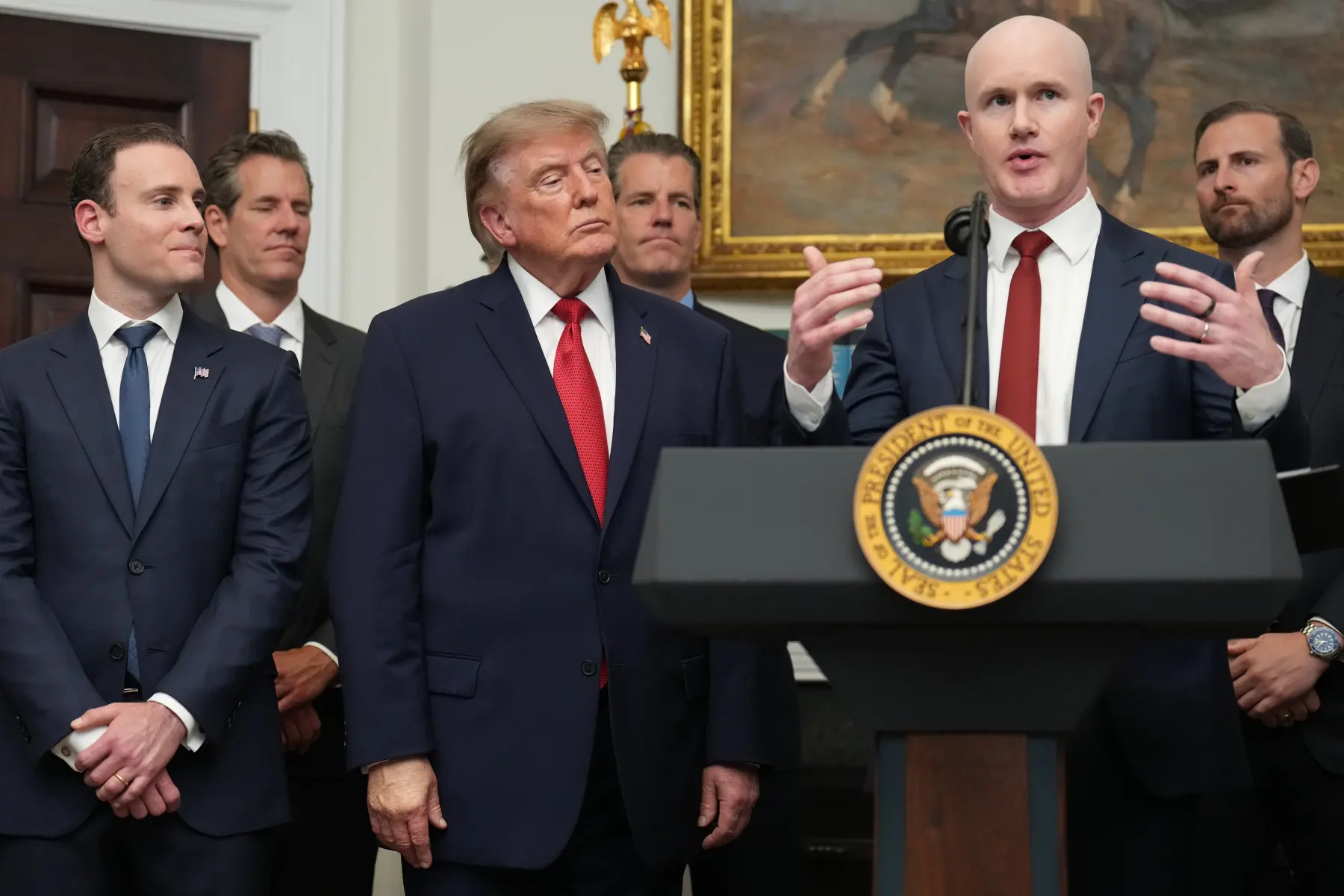
Coinbase CEO and co-founder Brian Armstrong speaks as President Donald Trump meets with technology leaders in the Roosevelt Room of the White House, Wednesday, Aug. 19, 2026, in Washington.
Jacquelyn Martin/Associated Press
hide caption
Jacquelyn Martin/Associated Press
He argued that the U.S. needs to “dominate” these new financial technologies — like crypto and prediction markets — and “write the rules that define the next generation of financial markets.” Selig is the sole member of the normally five-member CFTC commission, giving him unchallenged power over the direction of the agency.
Before his time at the CFTC, Selig was a corporate lawyer for cryptocurrency firms and prediction markets. His latest financial disclosure report shows that Selig sold between $65,000 and $150,000 in Bitcoin before he became a commissioner.
While Selig wants increased agency rule making for prediction and crypto markets, that requires a massive amount of work and staffing, according to former CFTC director Brian Young, who said the reduction in headcount limits the agency’s ability to write new rules.
“With the growth of prediction markets and digital asset trading, the [CFTC] really needs to augment staffing in order to meet these increased responsibilities,” Young said. “At the end of the day, they need people to process these applications.”
A former CFTC employee — who speaks regularly with current employees — told NPR that the CFTC is so understaffed that it is struggling to execute Trump’s 2025 executive order on cryptocurrency.
“My friends that are there are dying,” this former staffer told NPR on the condition of anonymity for fear of professional retaliation.
Earlier this year, CFTC Inspector General Christopher Skinner acknowledged the difficulty of short staffing in a recent annual report.
“The CFTC should consider human capital management as a top priority,” Skinner wrote. “To ensure the agency has the appropriate talent and skill sets to meet an expanding regulatory landscape.”
Meanwhile, the CFTC’s work load keeps growing.
In 2025, the agency greenlit six prediction markets — three times the average annual rate over the last decade. This year, the agency has authorized another 6 prediction markets with 18 applications pending.
After the Senate failed to advance a major crypto and banking regulation bill this summer, the CFTC announced this week that it is moving ahead with making its own rules without congressional input.
“The American people deserve clarity, certainty, and consumer protections in the crypto asset markets and the agency is committed to delivering this by incorporating crypto asset transactions into its uniform national market regulatory framework,” Selig said in a statement.
Still, as of July, the agency’s workforce was 16% below its decade-average or 100 staffers short. The CFTC is currently hiring for seven full-time positions.