It’s one of the busiest freight corridors in the United States, and it’s getting cleaner.
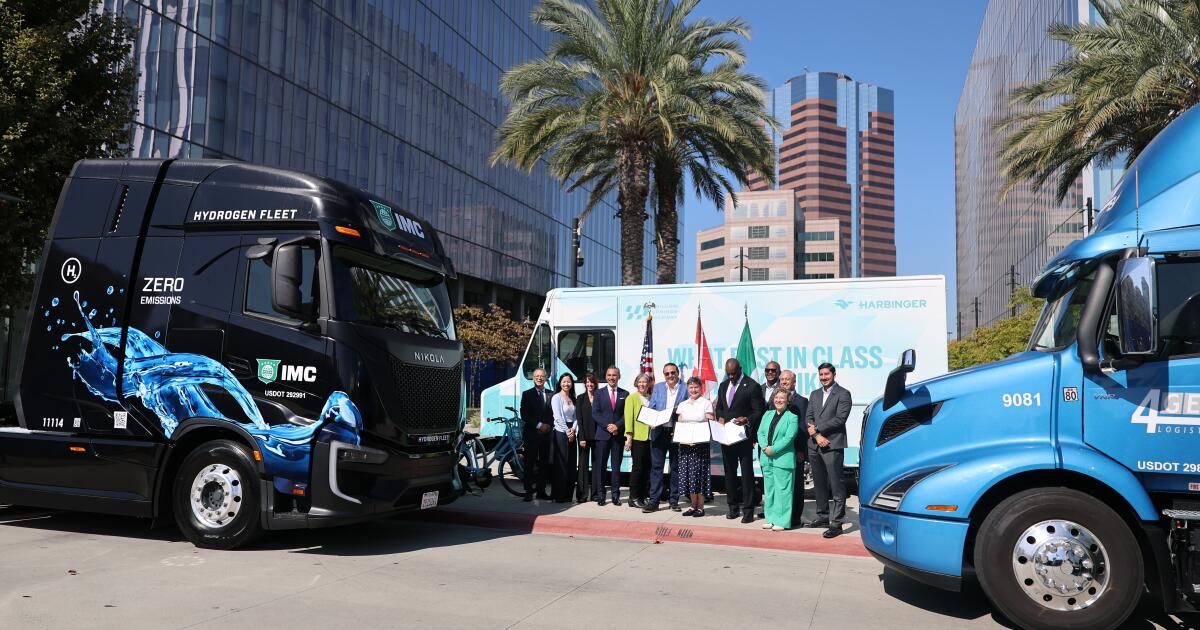
In the latest in the global effort to clean up heavy-duty freight, representatives from three countries gathered Wednesday at the Port of Long Beach to launch the British Columbia to Baja California Zero Emissions Vehicle corridor, or BC2BC, which, when complete, will make it possible for electric trucks to drive the length of the West Coast along Interstate 5.
The 1,381-mile corridor averages nearly 10,000 trucks each day — and sometimes as many as 35,000 — making it a backbone of North American freight movement for huge volumes of agricultural products, lumber, consumer goods and other cargo. About 550 miles of the I-5 corridor pass through urban areas such as Los Angeles.
Trucks move goods in a shipping container at the Port of Long Beach.
(Allen J. Schaben/Los Angeles Times)
Officials from California, Oregon, Washington, British Columbia and Baja California have now agreed to develop shared policies, investments and technical standards for the route. That includes set intervals between charging stations, similar siting of charging infrastructure and standards for installed chargers, among items outlined in a shared statement of principles.
Many chargers exist along the route already. Officials said the commitment will help fill in the gaps, and they aim to see Class 8 heavy-duty electric trucks driving the entire route as soon as 2030.
“Today marks the beginning of something extraordinary — a tri-national, five-state partnership to deploy charging infrastructure along Interstate 5,” said California Transportation Secretary Toks Omishakin. “This initiative will help create a more seamless, reliable zero-emission freight corridor than ever before.”
Heavy-duty trucks, which traditionally run on diesel, are an outsize source of air pollution. In California, the trucks are only 6% of vehicles on the road, but account for about 35% of harmful nitrogen oxide emissions and 25% of greenhouse gas emissions from vehicles, according to the California Air Resources Board.
Yet cargo freight has been hard to electrify because long-haul trucks need hundreds of miles of range while carrying heavy loads, and charging infrastructure has not been consistent.
Similar corridors are in various stages of development elsewhere in the U.S. and around the world, including an 800-mile East Coast corridor on I-95 between the Port of Savannah and the Port of New York and New Jersey.
But the West Coast corridor is “one of the world’s most ambitious examples,” said Stephanie Kodish, senior global director of the Global Drive to Zero Campaign at the nonprofit CalStart.
“What makes it so important is not just its scale, but that it demonstrates how governments can align policy, infrastructure planning and industry engagement across borders to accelerate the transition,” she said.
Other major green corridor projects include a 250-mile route between Rio de Janeiro and São Paulo, Brazil, and a 740-mile route between Bogota and Cartagena, Colombia. Kodish said all are advancing within their own specific contexts, constraints and geographies, but that the I-5 route, anchored by California, can be one of many models for how to achieve it at speed and scale.
“When you’re talking about BC2BC, you have a wonderfully strong foundation because of the investment and planning and stakeholder engagement within California that acts like a tethering,” she said. “And from that space, it can flow outward.”
Omishakin said it is too soon to say how much California will invest in the effort, or how many chargers it will ultimately entail, although the number is probably in the hundreds if not higher.
“What we’re doing today is saying we are committed to making sure that I-5 is one of the cleanest corridors in the country,” he said.
He said California, Oregon and Washington could also make use of federal funding from the National Electric Vehicle Infrastructure program, or NEVI. However, the $5-billion program has faced challenges from the Trump administration, which attempted to freeze it last year before a judge ordered its reinstatement.

Khari Burton, zero-emission vehicle program manager for IMC Logistics, stands beside a Nikola hydrogen-electric Class 8 semi-truck.
(Allen J. Schaben/Los Angeles Times)
It’s one of several efforts by the federal administration to undermine the EV transition in the U.S. and particularly in California, which has invested heavily in vehicle electrification. Last year, Congress revoked California’s authority to put in place its Advanced Clean Trucks rule, which would have required a significant percentage of medium- and heavy-duty truck sales to be zero-emission by 2035. The state sued over the revocation.
In May, Gov. Gavin Newsom launched a $1-billion rebate program for electric trucks, stating the state is committed to “clean technologies that will define the future of transportation.”
Locally, the move also builds on long-term electrification initiatives at the Port of Long Beach, one of the busiest cargo ports in the world, which has already committed to a zero-emission future.
The port will have almost 200 EV charging stations installed by the end of this year, according to chief executive Noel Hacegaba, and it recently launched smaller green truck routes connecting the port to the Central Valley and Tijuana, Mexico.
He noted that the new corridor will also mean cleaner air for communities near the port and along the route, which bear the brunt of their pollution. Diesel exhaust is a carcinogen and has long been a priority for port communities and others along heavy transport routes.
The new corridor will give the industry more confidence, said Alissa Kendall, director of the Institute of Transportation Studies at UC Davis. As they use it, their feedback will help government agencies refine the highway network, which is “essential given the constant pressure to show that public investments in these stations and technologies are sound, and that infrastructure is actually being utilized,” she said.
Fleet operators acknowledged that some drivers have been apprehensive to make the leap to zero-emission trucks because the technology is new and charging can be a challenge.
“But once the drivers actually start driving the trucks, they honestly don’t want to go back,” said Khari Burton, zero-emission vehicle program manager with IMC Logistics, a drayage company that moves freight from the port. “These trucks don’t have as much rattle, fumes, exhaust, things of that nature.”
Burton said the company has a fleet of about 200 trucks, 56 of which are now zero-emission, including hydrogen fuel cells and battery electrics whose charging time is factored into the logistics of the drive. He said he’s looking into adding a few Tesla semi-trucks, which have a 500-mile range, on par with diesel.
Burton said he’s thrilled by the prospect of an electrified I-5 corridor, and that the government commitment announced Wednesday will help bring more public awareness and support for growing EV infrastructure.
“I believe it is the future, and it’s something that is imperative for us to have — a change of pace when it comes to thinking logistics,” he said. “It can get done with less of a footprint.”